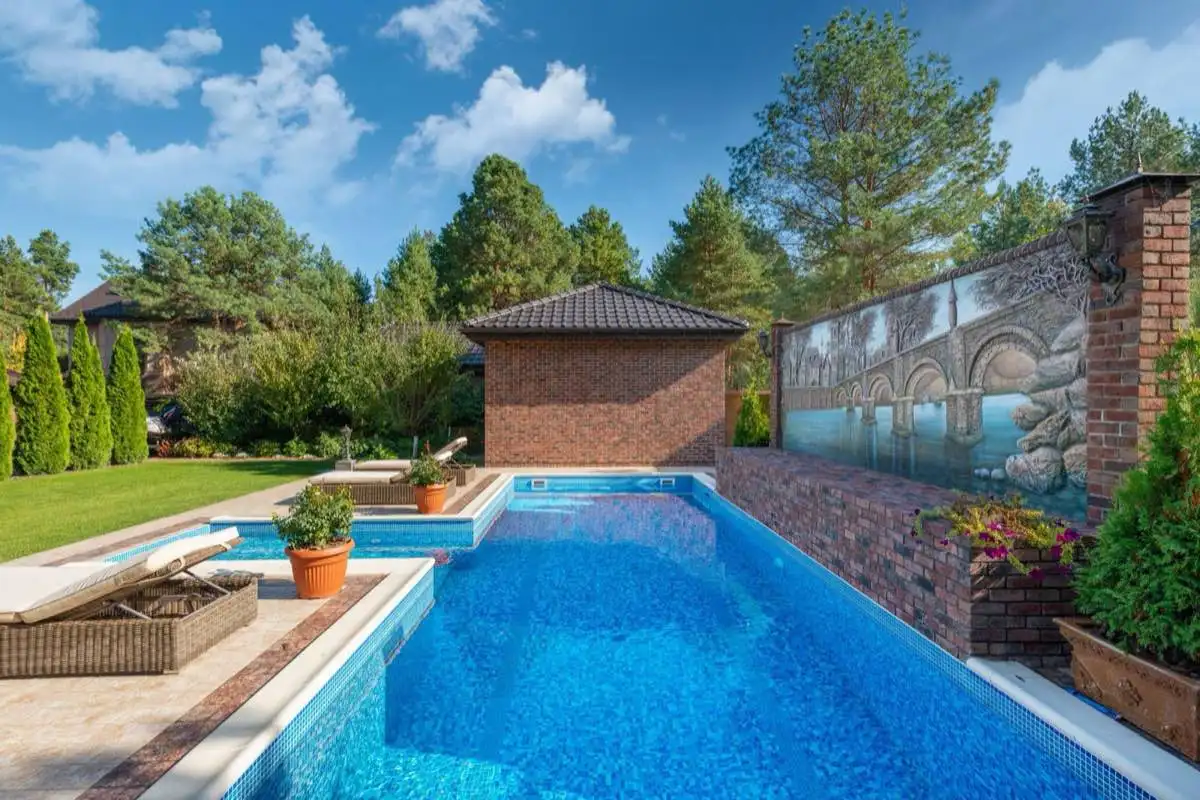
Short version: keep the salt at whatever your cell's manual asks for, pH between 7.2 and 7.8, free chlorine at 1–3 ppm, run the pump long enough to turn the water over once a day, and clean the salt cell every 3 months. Do that and a saltwater pool basically runs itself. Ignore it for a month in a FL July and you'll meet the green-water panic personally.
Here's the part the salesman skips: a saltwater pool is not maintenance-free, it's maintenance-light. The generator makes chlorine instead of you hauling jugs, but the water still needs balancing and the cell still needs cleaning. Anyone who told you "salt means never touch it again" was pricing the generator, not living with it. Below is the routine we run on Port St. Lucie pools, plus how to clean the cell yourself.
The 15-minute weekly routine
Most weeks, upkeep is genuinely quick. The saltwater part isn't the work; the water is.
- Skim and empty the baskets. Debris rotting in a basket is the fastest way to a chlorine demand your cell can't keep up with.
- Brush and vacuum. Saltwater doesn't stop algae taking the shady corner — it just gives you a head start.
- Test the water. Free chlorine (1–3 ppm), pH (7.2–7.8), and salt. Strips are fine for a weekly gut-check; a drop kit settles arguments.
- Check the level. Water below the skimmer mouth means the pump sucks air, and a saltwater pump running dry is an expensive noise.
Fifteen minutes, give or take. Skip it for three weeks and it becomes a Saturday.
The monthly + quarterly checks
Once a month, go deeper: clean the tile line, hose out the filter, and run a full chemistry panel — not just chlorine and pH but total alkalinity, calcium hardness, and cyanuric acid, the ones that quietly drift.
Every 3 months, open the generator and look at the cell. White crusty scale on the plates means clean it (next section). That habit is the difference between a cell that lasts 3 years and one that lasts 7.
Target levels (tape this to the pump)
| What to test | Ideal range | How often |
|---|---|---|
| Salt (salinity) | Your cell maker's spec (see below) | Monthly |
| Free chlorine | 1–3 ppm | Weekly |
| pH | 7.2–7.8 | Weekly |
| Total alkalinity (TA) | 80–120 ppm | Monthly |
| Calcium hardness (CH) | 200–400 ppm | Monthly |
| Cyanuric acid (CYA / stabilizer) | Your cell maker's spec (see below) | Monthly |
The bottom two rows belong to your equipment, not to the internet. Everything above them is general water balance, published by the Pool & Hot Tub Alliance (formerly APSP) and the same for any pool. Salt and stabilizer are the two a cell maker overrides — and they disagree with each other. Hayward's Aqua Rite manual asks for 2,700–3,400 ppm salt and 60–80 ppm stabilizer, and says outright that those two are the only places it departs from the APSP table. Pentair's IntelliChlor guide asks for 3,600–4,500 ppm salt (ideal 3,600) and 30–50 ppm stabilizer: more salt, less stabilizer, same job. So read the manual for the cell on your pad rather than any table, this one included.
A cell makes chlorine slowly and continuously rather than in a slug, so the sun gets more chances at it — which is the argument for carrying stabilizer high, and the APSP fact sheet does note stabilization improving up to around 100 ppm. The argument against overshooting is the CDC's Model Aquatic Health Code, which caps it at 90 ppm because bound chlorine kills more slowly. And if the cell reports low salt while your test kit says otherwise, the cell is usually dirty, not short on salt.
How to clean a saltwater pool cell
This is the step most guides skip, and it's the one that saves you $200–$700. Clean it when you see scale; leave it alone when you don't, because over-cleaning wears the coating off the plates.
- Power down. Turn off the pump and the salt system at the breaker. Do not skip this.
- Remove the cell from the plumbing. Note which way it came out so it goes back the same way.
- Rinse first. A hard spray from the garden hose knocks loose scale off. Sometimes that's all it needs — try this before reaching for acid.
- Acid bath only if needed. Mix 4 parts water to 1 part muriatic acid in a bucket or a cell-cleaning stand. Acid into water, never the reverse. Stand the cell in it for 3 to 5 minutes — you'll see it fizz as the scale dissolves.
- Rinse and reinstall. Hose it thoroughly, put it back, and turn everything on.
Rinse before you acid, and acid only when it's actually scaled. A cell cleaned three or four times a year in hard Port St. Lucie water hits the top of its 3-to-7-year lifespan instead of the bottom.
The green-water moment (and how to skip it)
You get back from a long weekend, the water's gone from blue to swamp, and you're wondering if the pool is now a pond. A hot week, a rainstorm that dumped the chemistry, a cell that quietly stopped keeping up. Don't panic-dump chemicals — check the basics. Is the pump circulating? Is the cell clean and actually generating? Is free chlorine near zero?
Most green-water calls we get in Port St. Lucie come down to a filthy cell, a filter that gave up, or a "superchlorinate" button nobody knew existed. Balance it, run the cell hard for a day or two, and brush like you mean it. Still green after 48 hours and the equipment is telling you something.
Seasonal: the part everyone forgets
Saltwater output isn't set-and-forget across the calendar. Cold water slows the cell, so many systems have a winter setting — output down as the water cools, up in peak summer. After heavy rain or a backwash, top up the salt, since diluting the water dilutes your sanitizer. And if you close for winter, run the cell in low mode or bypass it per the manual; freezing water inside a cell cracks it, and that's a repair, not a rinse.
In most of the Treasure Coast the swim season is long and hard closes are rare, which is exactly why the equipment takes a beating and the seasonal tune-up matters.
When to call somebody
The honest line: most saltwater upkeep you can do yourself with a test kit and 15 minutes a week. If the water's balanced and the cell's clean you don't need us, and anyone selling a weekly visit for a pool that's behaving is padding the bill.
Call somebody when the numbers won't hold no matter what you add, the cell throws errors after a proper cleaning, or you see corrosion or scale on the heater — that's an equipment problem, not a chemistry one.
That's where we come in. Port St. Lucie Pool Builders keeps saltwater pools clear across Port St. Lucie and the Treasure Coast — from weekly service that stays on top of the routine, to saltwater systems and cell replacements when the cell or pump finally quits. Deciding between salt and chlorine in the first place? Read our saltwater vs chlorine breakdown. For a straight answer and a free quote, call (844) 415-2670.
Ready for a free quote in Port St. Lucie?
Port St. Lucie Pool Builders — free estimate, clear scope, no pressure. Use the form on this page or jump to the homepage quote.
Related services in Port St. Lucie
Port St. Lucie Pool Builders money pages — go straight to the service you need.
- Pool Automation & Smart Controls →
Port St. Lucie Pool Pros installs automation that recovers after storms and still runs when phone apps are the least concern.
- Saltwater Chlorination Systems →
Port St. Lucie Pool Pros installs salt systems for humid coastal-adjacent pools with long swim seasons and storm interruptions.
- Weekly Pool Cleaning & Maintenance →
Port St. Lucie Pool Builders provides weekly pool cleaning for subtropical growth, storm weeks, and screen-cage yards across the Treasure Coast.
- Gunite & Shotcrete Pool Construction →
Gunite pool construction in Port St. Lucie runs on a permit calendar before it runs on a build calendar, and knowing that order is what keeps a project from stalling at month three.
- Screen Enclosures & Pool Cages →
Screen enclosure and pool cage construction in Port St. Lucie is engineered aluminum structure work, not bug-screen assembly, and on the Treasure Coast a cage has to be designed and permitted for county wind loads.
Frequently asked questions
How hard is it to maintain a saltwater pool?
Not hard, but not zero. In Port St. Lucie you're looking at about 15 minutes a week — skim, test, and empty the baskets — plus cleaning the salt cell every 3 months and balancing pH. The generator makes the chlorine for you; you just keep the water balanced and the cell clean. If you'd rather not, Port St. Lucie Pool Builders handles it: (844) 415-2670.
What salt level should a saltwater pool be?
Whatever the maker of your cell says, because they differ. Hayward's Aqua Rite manual asks for 2,700 to 3,400 ppm; Pentair's IntelliChlor guide asks for 3,600 to 4,500 ppm, ideal 3,600. Either way it is roughly a tenth as salty as the ocean. Too low and the cell stops making chlorine; too high and it can trip an error and corrode hardware.
How often should I clean my saltwater pool cell?
Inspect it every 3 months and clean it only if you see white calcium buildup on the plates. In Port St. Lucie's hard water, most cells need a light acid bath a few times a year. A cell that's cleaned on schedule lasts 3 to 7 years instead of dying early.
How do I keep my saltwater pool crystal clear?
Circulation plus balance. Run the pump long enough to turn the water over once a day, keep free chlorine at 1–3 ppm and pH at 7.2–7.8, and brush the walls weekly. Cloudy water is almost always a filter, circulation, or balance problem — not the salt.
What are the disadvantages of a saltwater pool?
Higher upfront cost, a salt cell that wears out every 3 to 7 years ($200–$700 to replace), and salt is a little rougher on some metal hardware and stone. Day to day it's cheaper and gentler — see our [saltwater vs chlorine breakdown](/blog/saltwater-pool-vs-chlorine/) for the full trade-off.
Local context
How this applies in Port St. Lucie, FL
Every article here is written from pool work done in Port St. Lucie and the Treasure Coast, so the numbers reflect local labour, permit and material costs rather than a national average. Your own job can land either side of them depending on access, the condition of what is already there, and the materials you pick — gunite and shotcrete construction, screen enclosures and pool cages, PebbleTec and quartz interior finishes.
The way to turn any of this into a real answer is to have someone look at your actual situation. The free estimate is free, itemized and written down, with no deposit and no obligation. Call (844) 415-2670 or start on the Port St. Lucie Pool Builders homepage.
Areas Port St. Lucie Pool Builders covers
Port St. Lucie first, then the surrounding communities of the Treasure Coast. Each has its own page with local detail rather than a copy of this one:
- Fort Pierce, FL — St. Lucie County, population 47,300
- Stuart, FL — Martin County, population 17,400
- Jensen Beach, FL — Martin County, population 12,700
- Palm City, FL — Martin County, population 25,900
- Hobe Sound, FL — Martin County, population 13,200
- Vero Beach, FL — Indian River County, population 16,400
Or jump to the full list of Port St. Lucie services.
More from the Port St. Lucie Pool Builders blog
- How Much Does an Inground Pool Cost? Port St. Lucie
An inground pool in Port St. Lucie, FL runs about $45,000 to $75,000 for gunite.
- Fiberglass Pool vs Gunite for Port St. Lucie Yards
Fiberglass vs gunite pools compared on cost, install time, upkeep, and lifespan — plus which fits a Port St. Lucie, FL backyard.
- Pool Plaster vs Pebble Finish for Port St. Lucie Pools
Pool plaster vs pebble finish in Port St. Lucie, FL — cost per square foot, how long each lasts, and when white plaster wins.
The Port St. Lucie Pool Builders Team
pool specialists serving Port St. Lucie, FL
Written by the Port St. Lucie Pool Builders team — insured pool pros with 15+ years serving Port St. Lucie, FL and the surrounding area.